
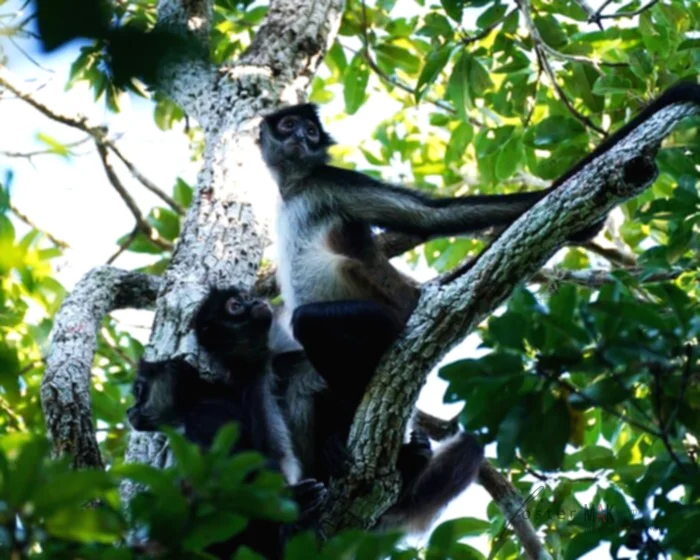
Spider monkeys share insider knowledge to find the best food sour
In the dense and sprawling rainforests of Central and South America, a fascinating social behavior is catching the eyes of researchers. Spider monkeys share insider knowledge within their groups, helping each other locate the most bountiful food sources. This remarkable behavior not only highlights the complexity of their social interactions but also offers insights into the evolutionary advantages of knowledge sharing in the animal kingdom.
Complex Social Networks Among Spider Monkeys
Spider monkeys are known for their intricate social structures, which are among the most complex of any New World monkeys. Living in large, loose-knit groups, these primates exhibit a fission-fusion dynamic where smaller subgroups form and dissolve throughout the day. This fluid social system requires advanced communication skills and a keen understanding of social dynamics. Researchers have observed that within these networks, spider monkeys share insider knowledge about food locations, thereby enhancing their foraging efficiency.
The sharing of information is facilitated by vocalizations, grooming behaviors, and physical gestures. These interactions are not just random acts of socialization; they serve a critical function in the survival and well-being of the group. By exchanging information about where to find ripe fruits or nutrient-rich leaves, spider monkeys can minimize the time spent searching for food and maximize their energy intake. This cooperation is especially important in the competitive environment of the rainforest, where food availability can fluctuate dramatically.
Evolutionary Benefits of Knowledge Sharing
The practice of sharing food-related information among spider monkeys raises intriguing questions about its evolutionary benefits. From an evolutionary perspective, the ability to share insider knowledge represents a significant advantage. It fosters group cohesion and strengthens social bonds, which are crucial for survival in the wild. By helping each other locate food, spider monkeys can ensure the survival of their kin and, by extension, the propagation of their genes.
Moreover, this behavior may also reduce intra-group competition for resources. When all members of the group are aware of food locations, there is less likelihood of conflict arising over limited supplies. This peaceful coexistence is vital for maintaining group stability and ensuring that all members, including the young and weaker individuals, have access to necessary resources. As a result, the entire group benefits from increased survival rates and improved reproductive success.
Observations in the Wild
Field studies have provided valuable insights into how spider monkeys share insider knowledge. Researchers have documented instances where experienced individuals, often older females or dominant males, lead their groups to food sources. These leaders use a combination of vocal cues and physical gestures to guide their followers. Interestingly, the followers appear to trust the leaders’ knowledge, as evidenced by their willingness to travel long distances based on these cues.
In one particularly illustrative study, researchers followed a troop of spider monkeys in the forests of Costa Rica. They noted that when a knowledgeable leader discovered a fruiting tree, they would emit specific vocalizations that attracted others to the location. The successful dissemination of this information allowed the entire group to feed efficiently without engaging in aggressive competition for the newly found resource.
Cognitive Abilities and Social Intelligence
The ability of spider monkeys to share insider knowledge is indicative of their advanced cognitive abilities and social intelligence. These primates are capable of complex thought processes, including memory, problem-solving, and an understanding of cause and effect. Such cognitive skills are essential for processing and sharing information about food sources.
Furthermore, the social intelligence of spider monkeys is reflected in their ability to recognize and remember the individual members of their group. They can discern who holds valuable knowledge and who is likely to lead them to food. This recognition is critical for the effectiveness of knowledge sharing, as it ensures that information is disseminated through reliable channels.
Implications for Conservation Efforts
The discovery that spider monkeys share insider knowledge has important implications for conservation efforts. Understanding their social behaviors and foraging strategies can aid in the development of more effective conservation programs. By recognizing the importance of social structures and communication in spider monkey populations, conservationists can devise strategies that protect these critical aspects of their behavior.
For instance, conservation efforts could focus on preserving the habitats that support the complex social networks of spider monkeys. Ensuring that these primates have access to large, contiguous areas of forest will allow them to maintain their fission-fusion social systems and continue their knowledge-sharing practices. Additionally, conservation programs could incorporate educational components that highlight the sophisticated social behaviors of spider monkeys, thereby raising awareness and support for their protection.
Spider Monkeys Share Insider Knowledge: A Model for Understanding Animal Behavior
The phenomenon of spider monkeys sharing insider knowledge serves as a model for understanding similar behaviors in other animal species. It challenges the traditional view of animal behavior as purely instinctual and suggests that animals are capable of sophisticated social interactions that resemble those of humans. This recognition of complexity in animal behavior opens new avenues for research and deepens our appreciation of the natural world.
Spider Monkeys Share Insider Knowledge: Insights into Human Evolution
The study of spider monkeys and their information-sharing practices also provides insights into the evolutionary origins of human social behavior. As our closest living relatives, primates offer a window into the past, helping researchers understand how early humans might have developed similar strategies for cooperation and communication. The parallels between spider monkeys and early human societies suggest that knowledge sharing could have played a crucial role in the development of human culture and social organization.
As scientists continue to investigate the behaviors of spider monkeys and other primates, they uncover more about the intricate web of social interactions that sustain life in the wild. The revelation that spider monkeys share insider knowledge is a testament to the complexity and adaptability of these remarkable animals, offering valuable lessons for both the scientific community and the broader public.